Showing posts with label Biography. Show all posts

Wednesday, 1 March 2023

Number 8.5 - This is Going to Hurt - Adam Kay


I actually read this last week, in the middle of the Paul Auster book, since I had a train trip midweek and this fit in my coat pocket (unlike the massive 760 page plus hardback).

This continues the theme for February of reading biographies.

Adam Kay was one half of comedy musical act Amateur Transplants, very funny and very sweary. Check out their song London Underground for possibly their finest hour.

These days he's writing for TV while he's not touring with his music. Before that, he was a doctor in London. This book is extracts from his diary during that time.

This is without doubt the funniest thing I've read in years. It reduced me to helpless tears of laughter several times, and at least one uncontrollable giggling fit that lasted nearly 10 minutes.

Kay has a knack for phrasing in a way that makes almost anything funny. Some of the stories in this really shouldn't be quite so hilarious, but the way he tells them makes it, as per the Stephen Fry quote on the cover, painfully funny.

It is also heartbreaking as per the Jonathon Ross quote. Whilst the majority of the book keeps you giggling out loud, every now and then, he pulls the rug out from under you with a genuinely sad story. The story of why he quit as a doctor is particularly sad. 

Another thing this book does his highlight exactly how much stress our NHS staff are under (and this was back in the noughties, it's only gotten worse in the intervening years). As well as making us laugh, this is a  heartfelt plea to save the NHS.  The point is made repeatedly how vital the NHS is to the country, and how pressured the doctors and nurses are. Humour is a great weapon to show the absurdities and truth behind  the kind faces you see when you enter an NHS hospital.

I work in IT for the NHS as my day job, and so much about the way the organisation runs rings true. I'm lucky in having a 9-5, but my job roles over the years have given me insight into how the wards run.  This book really threw open any blinds that were still closed to me. 

So this isn't just one of the funniest books you'll ever read, it's one of the most important if you value the health service in this country.

Saturday, 25 February 2023

Number 8 - Burning Boy - Paul Auster


Continuing the theme for this month of biographies, this is Paul Auster's massive tribute to the life and works of Stephen Crane.

I'll admit that I had no idea who Stephen Crane was before I picked this up (although I did know there was a book called Red Badge of Courage, it would have foxed me in a pub quiz if asked who wrote it). That ignorance is now well and truly shattered and Crane has been added to my reading list for later in the year (either in my new writers month or short fiction month).

Crane died heartbreakingly young at the age of 29 in 1900. He left behind a fair sized bibliography for a man so young. Auster goes into detail on the circumstances behind the most auspicious of these writings.

I will admit that the only reason I bought this was Paul Auster's name on the cover.  The sheer size of this book has been intimidating me in the months since I found in the sale section of my local Waterstones. For an idea of how big this book is, see the next photo, where this is the size of my previous three books combined.

This book is a love letter from Auster to one of his own literary heroes. Auster makes the case for Crane being the inventor of modernism in writing, and therefore responsible indirectly for so much current literature.

His love for the subject matter shines through on every page. there are so many facts and figures and quotes thrown at us that it becomes quite dense in places.  

The extracts from Crane's work, and the analyses of why they work is fascinating, and despite the density of the information, this is never a struggle to read and is never boring. Crane comes across as a naïve and occasionally foolish man in his private and financial affairs, but a genius when he has a pen in his hands.

One message that comes through loud and clear is how businessmen have always taken advantage of the innocence of new artists in any field, and the book serves as a cautionary tale in reading contracts.  Despite all the success Crane experienced as a writer, he made very little money from his work because of one bad contract after another.

Auster's prose is uncharacteristically dry, but, as I said, never boring. Despite knowing the outcome of the book, there was still an emotional charge when Crane's death (and his wife's) were described.

This is by far and away the longest piece of non-fiction I've ever read. It's a fascinating insight into the life of an important writer, even as he starts to sink into obscurity. Apparently Red Badge has been dropped from school curricula in the States, (and never has been required reading in the UK to my knowledge) and therefore a new generation of readers are missing out. 

Maybe this book will spark a new interest in his writing.  It has for me, definitely.  

Sunday, 5 February 2023

Number 6 - Things The Grandchildren Should Know - Mark Oliver Everett


Book 2 in my theme for this month of Biographies, and a massive improvement on the dullness that was the Years.

Mark Everett (aka E) is the son of Hugh Everett III the man who postulated the many-worlds theory of quantum physics. E is also the lead singer of one of my all time favourite bands - Eels.

This book details his life up to and including Eels's 5th album Blinking Lights.

It's a fascinating look into a life packed with more tragedy than you might expect to be possible. Yet E never asks for sympathy from the reader - but this particular reader found myself upset along with him as he described the deaths of his family.

He tells his story in a refreshing, no nonsense way. There are no bells and whistles to the writing.  He just tells us the key moments in his life that formed the man he has become, from his far from perfect childhood, through grief and loss as an adult, and his battle with depression. 

The story behind the writing of Electro Shock Blues was truly heartbreaking and that album has a whole new set of resonances since I read this book.

This is far from a misery memoir though. It's frequently funny and the whole book is shot through with life affirmation and hope for the future.

This was a reread for me. When I first bought it many years ago, i read 70 pages on the bus home from the shops, and finished it the next day.  This time around, I've read it in 2 days again.  It's one of the easiest and fastest reads I know. 

Yet despite the easiness of the reading (and easy reading is hard writing), this book will move you. It will make you laugh. it will make you cry and it will give you hope for your future.

Mark Everett has always written great lyrics.  In this book he proves he's a great writer.

Saturday, 4 February 2023

Number 5 - The Years - Annie Ernaux


After three GBP books back to back, I needed to read something lowbrow. However my bookgroup[ choice was this. I'm not sure if it was this book that won the Nobel prize, or whether she just won it in general. But it certainly doesn't make for the lowbrow I needed.

This is Annie Ernaux's memoir of her life in France from birth in 1041 do the date of publication in  2006. Alongside her own life she also gives impressions and descriptions of France itself, it's politics and sociological movements.

All in all it could be fascinating, and many people think it is. two members of the book group agree with the quote on the back saying it's the greatest book they've ever read.

Personally, the subject matter didn't strike me intellectually, neither did the style of writing. It's written in a very removed manner. So far removed that there's zero emotional impact to the writing.  Combine that with my lack of intellectual engagement with this book and I found it all just a bit dull. At times it just seems to devolve into list after endless list of things, none of which I found intriguing or engaging.

There are a few books I've reviewed on this blog where I say how much I loved a book, but I could see how and why other people would hate it.  In this case, it's the other way around.  I will never pick up another book that she's written. I was so glad when I finished this.  it was one of those books where, when you put it down, you can't pick it up again. But i understand why other people rate it as highly as they do.

I can appreciate the skill in the writing, the occasional nice turn of phrase, and I understand the point of the book and where she was aiming with the way she wrote it. It just didn't resonate with me. A literary equivalent of "it's not you, it's me".

So, too sum up, skillfully written, but dull (IMHO - many people disagree).

Monday, 30 January 2023

Number 4 - After Sappho - Selby Wynn Schwartz


Number three in my Galley beggar Press themed month. There is one (now two) more but ehy may have to wait.

I've had this in my TBR for nearly a year and I have to admit to not being too keen on it from the description.  It really didn't sound like my kind of book - a feminist LGBTQ tract (with emphasis on the L) detailing the lives of assorted early campaigners.

However, it's always good to move out of your comfort zone - one of the reasons I decided to theme books this year, to deliberately force myself to read some I might not have read otherwise.

After the florid writing in the last two books, the return to short sentences and a simple vocabulary was a really welcome change of pace.

This is one of the most eye-opening books  I've read in many many years. Told in short segments, rarely if ever more than one page long (very rarely more than three paragraphs), each segment headed with the relevant name/date/title, it gives us glimpses into the lives of dozens of real life campaigners for women's rights.

With this structure it does feel very bitty, and there's not much of a n obvious central story to hang your attention to. However this doesn't stop it from being an engrossing read throughout. The struggle for recognition is the central character/theme of the book.

Schwartz manages to celebrate the women in the history without blaming ALL men for the problems, just the men in charge. And those women she celebrates had to put up with far more than I ever imagined. The details of the law that meant a man could rape a teen girl and she would be forced to marry him were shocking. Along with this, Schwartz makes it clear how women weren't even citizens of turn of the 20th century Italy (and elsewhere).

The title comes from the unifying factor in the early segments that the women are inspired by the writings of Sappho, and extracts from Sappho's surviving works are scattered throughout. We read of their efforts to emancipate themselves (in some cases through sheer disregard of the rules society expects them to adhere to) from the systems holding them back and the eventual formation of the Bloomsbury Group.

I did have some minor annoyances with this book. The style gets a little grating after a while, and I'm sure I missed a lot of references that any feminist would see a mile away. The writer admits in the text late on that she has deliberately excised any men from the narrative -and even names a few of the allies to the cause that she has removed from the story. The segment that bemoaned the number of women who died in World War 1 was the most annoying part. Not a mention of the generation of young men dying in the fields.  

I suppose male centered histories have erased women's contributions, but is it maybe a little bit petty to not only excise men from the story and then admit to doing it deliberately? 

These are minor quibbles though. This book was so much more than I thought it would be, and has changed my way of thinking on several fronts. On that level, this is a definite success.

Saturday, 21 January 2023

Number 3 - My Mind To Me A Kingdom Is - Paul Stanbridge


Secomd book in my Galley Beggar Press themed month...

This is an odd one. 

It's a book about distraction. It's about an awfui lot of things, but they're all distractions.

In 2015, Paul Stanbridge's brother hanged himself. This book is a sort of a journal/biography of Paul and his attempts to deal with the loss.

And he does that through distraction.  There are a mountain of facts and figures about a myriad of topics.  It starts off with his research into how and when the Germanic Sea was renamed the North Sea, complete with diagrams and digressions and mini-biogs of noted historical cartographers (also some obscure and hitherto un-noted cartographers).

At the heart of it all is his not wanting to deal with his loss.  The various rabbit holes of research he throws himself into, all the obsessions he creates for himself are shields against his feelings.  The only thing he never researches directly is the suicide that lies at the heart of the book like an unwashed and festering sore.

The style of writing is longwinded, never using one word when an entire lexicographer's toolkit of thesauruses thesaurii) will supply alternative extraneous clauses and sub-clauses to suffice in its place, and run on sentences are common, sometimes taking up entire pages with complex and occasionally almost incomprehensible additional verbiage.

However, this doesn't stop the book from being a fascinating read.  The endless stream of facts and figures and random trivia is really interesting to read. There's something almost soothing about the rhythms of the writing. 

It's possibly a bit too emotionally distanced from the source of his grief. As much as I'm aware how traumatic the event must have been, there was never the palpable sense of loss that I've felt in other books dealing with similar subject matter.

Back to my fist point, it's an odd one. Is it a beautifully written book despite its long-windedness? Yes. Did I enjoy reading it?  Yes. Is it intellectually engaging? Yes. Did it emotionally engage me - I'm not sure.  Probably not.  Would I read it again?  I don't think so. Was it worth reading? A definite yes.

Your mileage may vary. 

Wednesday, 7 December 2022

Number 68 - Lucky - Alice Sebold

I try to read at least one biography a year to shake things up a little. I realised I was nearly in December and hadn't read one yet so I grabbed this one off my shelves where it's been sat for many many moons.
When Alice Sebold was a student, she was viciously attacked in a local park. The attack formed the basis of The Lovely Bones. However, while she was writing that book, she realised she needed to put the true story out there as well and she stopped her work on The Lovely Bones to write this.
I have to say that this was a very difficult read. Not because of the prose, the language used is clear and concise, with no flourishes.  It couldn't be easier to read on that level. Indeed, it's a compulsive read on that level.
What makes it difficult is the subject matter. As previously mentioned, this is about a violent sexual attack and its aftermath.
The attack is described in vivid detail with nothing left to the imagination. She keeps the writing cool and dispassionate. This makes the horror of what happened to her so much more acute.
The rest of the book deals with the aftermath, including family and friend reactions (none of which are good enough or can be), the trial and conviction of the rapist, and a seeringly honest description of her life with PTSD even after her allegedly successful outcome of the story.
It's a long time since a book put me through the emotional threshing machine quite as much as this one did. Her description of the trial made me physically angry and the cross examination she was given regarding her identifying her attacker - particularly since they had samples of his hair in evidence which proved it was him almost beyond doubt. At the end of the trial chapters I had to put the book down and cry.
Thankfully, there is a thread of hope running through the book, or this would have been a truly unbearable read. As it is, this is emotionally tough, but compulsive and one of the most heartfelt biographies I've had the "pleasure" of reading.
I can't recommend this book too highly. It doesn't come across as a misery memoir.  It's far too well written for that. There's nothing sensationalised about any of the details of her life. It's a book that will stay with me for a long time.

Sunday, 3 April 2022

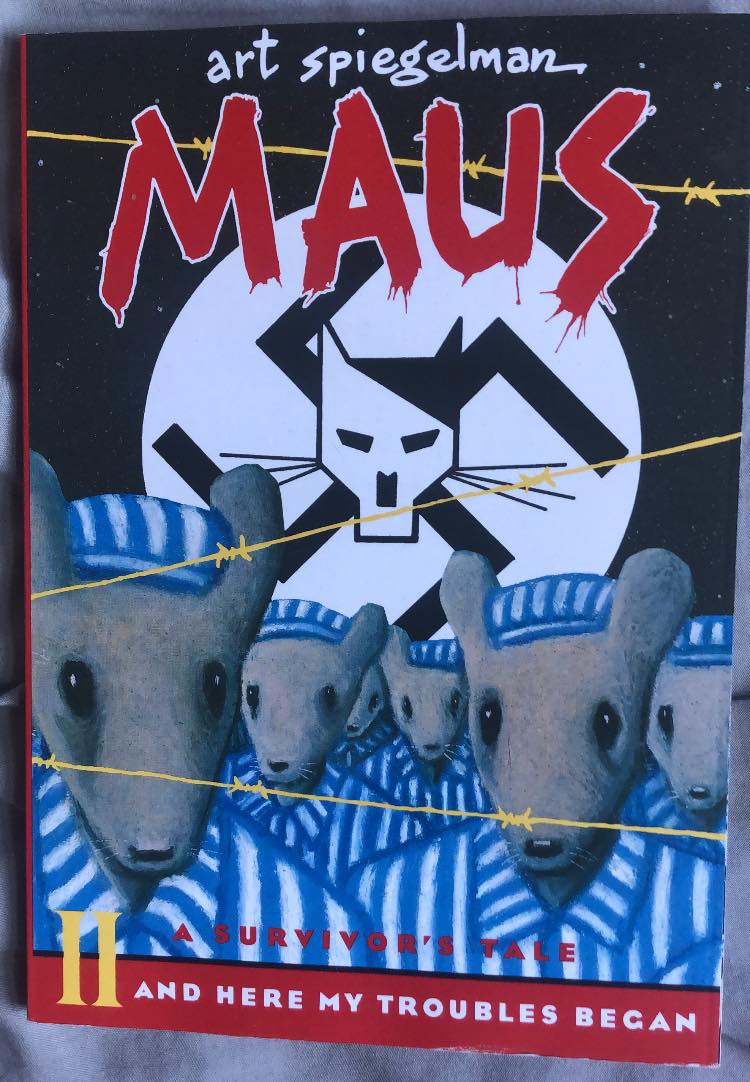
Number 20 - Maus ii - And Here My Troubles Began - Art Spiegelman


 Maus I finished where Vladek Spiegelman, after evading the Nazis for years, was captured and sent to Auschwitz.

This volume completes his story, with a detailed rundown of the atrocities he witnessed and his almost miraculous survival.  The first version of that sentence said miraculous escape. but that's the wrong word.

In my write up on volume 1, I said it was powerful and disturbing. Compared to this, volume 1 is mild. 

If this was pure fiction I would say that it was impossible. Humans aren't that vile to each other.  This is unbelievable.  But this is a true story, even it it has been anthropomorphised into animals. It's an eyewitness testimony of the most disgusting crimes against humanity in living memory.

The meta part of the story, where Art himself interviews his father, is deeply moving and scarily honest. Art shows us all his own and his father's faults as people. How much of his father's personality can be excused by what he went through? Art clearly shows his exasperation at his father, and his guilt for not wanting his father living with him despite the amount of help he clearly needs. 

This being a true story, don't expect pat answers to any questions raised. Do expect to be shaken to the centre of your existence. The descriptions of the atrocities at the Auschwitz and Dachau camps are worse than any horror story. I was thankful that the characters are all drawn as different animals.  It makes the horror of what happened a bit easier to process. Until of course, the moment that it did process and then... 

This is one of the most important books about the holocaust. The artwork makes it so much easier to digest without diluting the power of the story or the horrors humanity is capable of inflicting on each other.

It's a genuinely traumatic read.  But we have to learn the lessons from history. This is one bit of history that cannot ever be allowed to repeat itself. 

 I bought book one when it first came out and struggled to find an affordable copy of book 2 recently. However its easily available as an omnibus version of both books. There's no excuse to not go out and buy it.

Saturday, 12 March 2022

Number 15 - Moonglow - Michael Chabon


Michael Chabon writes gorgeous prose.  I read The Yiddish policeman's Union a few years back, and while I'm sketchy on plot details, I remember really loving it.  So much so that I now have 4 more of his books in my TBR.  So I was quite happy when this was chosen for this month's book group (even though it wasn't one of the ones I already had, so it cost me money to go out and buy it)

The meeting was held a week ago last Wednesday and I've only just finished the book today.

I wasn't the only one in the group who hadn't finished.  This book is unique in the history of my book group in that not one person had finished it.

It's a memoir of Michael Chabon's maternal grandfather - or it purports to be. The first person narrator is one Mike Chabon and he's telling us about the stories his grandfather told him from his deathbed.

The old guy apparently had an interesting life.  A decorated veteran of WWII, an ex convict married to a woman with severe mental health issues, a rocket scientist in his spare time, and as he got older, a hunter of killer snakes in his retirement village, trying to avenge the many pets which have gone missing.

I say apparently, because the book is apparently fiction. It's hard to tell what it is. It is filled with Chabon's trademark luscious prose, layered narrative and deeper hidden meanings and metaphor.

On the strength of the quality of writing, I should love this book unreservedly...

The problem is that I don't. And one of the annoying things about this book, is that it makes me feel that it's a ME problem and not the fault of the book that I've actually found it a struggle to get through.

The structure of the book doesn't help.  In a well done attempt to recreate the randomness of memory and recall, the book is very choppy and bitty.  It takes till about page 180 before two consecutive chapters are set in the same timeframe. Every chapter up until that point requires a mental reset and effort to work out where in the timeline we are.  This does help to get across a whole lot of background information and the piecing together of the jigsaw pieces is sometimes quite enjoyable. 

It has made me laugh out loud frequently. It has made me feel sorry for the family. A chapter close to the end dealing with his mother's miscarriage was particularly moving. But this isn't a book I think I would read again, despite the fact that knowledge of the whole story will almost certainly grant more insight to events described earlier on, and to see the myriad of patterns  in the storytelling.

It's frustrating.  I can't fault the book, but it was a real struggle to get through. Your mileage may vary but this is a 6/10 or 7/10 at most for me.

Friday, 18 February 2022

Number 13 - Maus - Art Spiegelman


Arguably one of the most important graphic novels ever written, this is Art Spiegelman's retelling of his father's experiences in Poland in the run up to and during World War II at the hands of the Nazis.

With the recent controversy when a Tennessee school board decided to ban the book, I decided it was time to dust down my copy and have a reread.

There are two stories running through this book, the tale of Vladek Spiegelman's early life, and how he survived till 1944 without landing in a concentration camp, and the More personal tale of Art's fractious relationship with his father.

The story of Vladek's time in Auschwitz is covered in volume 2 - which I've had to order. I'm not sure why I don't have a copy, but it wasn't the easiest thing to source at a reasonable price.  

The artwork is quite basic, and the mice are purposefully not easy to tell apart. After all, the dehumanisation of the Jews in nazi Germany is a central theme of the book. That, and the comparison with vermin, makes the  portrayal of the Jews as mice both horrific and ironic. The Poles are shown as pigs and Nazis as cats.

The juxta positioning of the two stories both serves to make the book feel more personal, and to accentuate the horror of the holocaust. It becomes easier to read without becoming a misery memoir even though the flashbacks to the 40's become more and more distressing with every loss that Vladek experiences.

I picked this book up when Art Spiegelman was giving a talk and signing copies at a local branch of Waterstones. It remains one of the  most interesting author events I've attended.

This story is a lesson from history that should never be ignored. Any time a group of people is demonised as something less than human, we should ask why, and what is it leading to. 

This book makes it clear that the holocaust didn't start with the gas chambers. They built up to that. They kept that part secret from the populous at large for as long as they could. 

There is only one type of person who would want to ban this book.  This book is a clear warning about that type of person.  It should be required reading for everyone.

Saturday, 11 December 2021

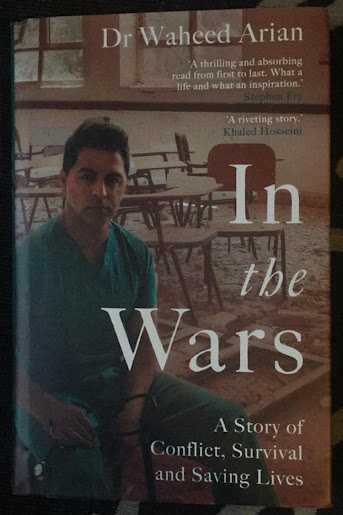
Number 100 - In the wars - Dr Waheed Arian


Number 100 for the year! This was my book group read and the second autobiography in a row. I did a bit more research and Chump Change is almost certainly a fictionalised autobiography.

However, whereas Chump Change was a warts and all decent to his lowest point with a glimmer of hope at the end, this one takes almost the opposite path.  This one starts with his horrendous childhood and takes us through his pathway out of poverty and danger and to his current status as head of a prestigious charity and a doctor in the NHS.

The opening sections of the book were certainly the most interesting. His childhood in Afghanistan with breaks as a refugee in Pakistan before moving to the UK was filled with drama and incidents. He (or his ghostwriter) paints a vivid picture of the precariousness of existence in Kabul. 

Once he reaches Britain, his fortunes changed very much for the better.  He manages to enroll in a college while holding down two jobs  to get his A-levels before he is accepted into Cambridge University for his medical degree.

His work ethic puts most of the rest of the world to shame. He comes over as a truly remarkable man in every way.

This is where the cynic in me wonders what has been left out of the story. This is the only autobiography I've ever read where the author doesn't reveal even a single wart. The book reads in the end like an advert for his charity (which from the last two chapters, that's exactly why he wrote it) so I can understand that he doesn't want to show himself in a bad light at any point.  This book isn't warts and all. it's a plea to donate to his -very worthy indeed- charity. 

All in all it's a very interesting book, engagingly told. It shines a light on life experiences in war zones, the lengths people have to go to to escape, and the confusion and problems encountered trying to set up a new life in a totally different culture. 

If it was fiction I'd be complaining that the protagonist is too perfect. Was it really nothing more than youthful naivety when he didn't realise the "travel agency" that sent him to the UK wasn't completely on the level - despite fake passports etc?  Please let us see that you have some human failings other than mildly amusing cultural and lingual misunderstandings at university. 

It feels awkward admitting that I kind of feel that way about this even though it's non-fiction. However, I expect unfettered honesty from the author of one of these books, so I should be honest in my review. I am cynical by nature and struggle to believe that people can be this flawless. I want to see the whole person when I read an autobiography, not just the good bits.  Although maybe he's just a better person than me and deep inside I'm jealous. 

The work he's done is amazing. he's achieved more than I ever will in my life. He passed on a guaranteed consultancy post to concentrate on the charity work. Even if he hasn't shown us any warts, he's still a remarkable man doing great work. His charity deserves all our support, it's doing great work and actually improving things on the ground in places like Afghanistan. If you can support his charity Arian Telemedicine, do so.  They need every bit of help they can get. 


Wednesday, 1 December 2021

Number 99 - Chump Change - Dan Fante


Dan Fante is the son of Jon Fante.  As any people who read these reviews regularly will know, I discovered Jon Fante entirely by chance a couple of years back because I liked the title of one of his books (1933 was a bad year). he rapidly became a firm favourite of mine. 

I'm close to having read everything Jon Fante ever published and I wondered if the talent ran in the family. So I ordered this online - his books don't show up in Waterstones the way his dad's do - and I'm so glad I did.

The unflinching gaze at the underbelly of life is well and truly present in the writings of both father and son. 

This book is one of the most disturbing things I've read this year.  I find myself hoping that it is complete fiction and not based on Dan Fante's real life.

However - the lead character is Bruno Dante.  His father is Jonathan Dante -  a novelist and screenwriter dying from diabetes. We meet him in the book, lying on his deeathbed, a shriveled husk of his former self with no lower legs due to his illness, and only breathing through a sheer refusal to die just yet. Jon Fante died of diabetes - he too had lost his feet to the disease. 

 Jonathan Dante's book that is referenced in this is called Ask the Wind.  The last of the Bandini novels was Ask the Dust. There are so many similarities between Jonathan Date and Jon Fante it's impossible to surmise anything other than Dan wrote his father into this book under a very thin veil indeed.

Given that the father character IS his real life father, how much of the character of Bruno is Dan Fante?  

Bruno is not a nice man.  He's an out of control alcoholic with a mean streak a mile wide and totally self destructive.  We meet him first when he's released from rehab a few days early so his wife can take him back to LA to see his father before he dies.

What follows is a compulsive and horrifically readable account of alcoholism and a crash to the bottom. I'm not sure Dante makes one good decision at any stage of the book. We certainly can't root for him and his behaviour. We can't sympathise in the slightest.  But Fante's prose makes us understand him and empathise. We can hope that he might turn a corner somewhere, but it never seems likely. This spiral is a bad one. The only thing close to a redeeming feature is his attempts to look after the dog, and he's not even very good at doing that.

This book messed with my dreams and gave me a sleepless night. Most horror novels I read don't manage that. His depiction of broken humanity is so convincing that it hits on a deep deep level. However there are shafts of humour shining through. This isn't a misery memoir.  It's compelling in part because of the jet black humour used to illuminate the darkness.

I will certainly be tracking down more of his work.  He truly manages to carry on his father's legacy.


Tuesday, 9 November 2021

Number 92 - Birthday - Cesar Aira


I picked this up very randomly in Waterstones on Sunday.  Basically because it was very thin.  The description said it was about a guy who just past his 50th birthday and a chance conversation made him reevaluate his life.

This did resonate with me a little since I turned 26 and a bit quite recently myself.  It feels dishonest if the bit is more than half the total...

I'm not sure this classes as a novel or even a novella.  It's more like a 80 something page essay.  There's no real story, just a geezer ruminating on the fact that he's not young any more.  He tells us his thoughts about a host of the big subjects in life.  He makes a few good points.  He waffles on about some tripe as well.  

He talks about his plan as a novelist and how he's not convinced he's done enough.  He's refreshingly honest in his self assessment, but not seeringly honest. I can't say I came away from this book with any real impression of the writer as anything other than a slightly self obsessed bore. 

It kills a couple of hours. There are a few nice observations. It's generally quite readable. I can't really praise it much more than that.

Sunday, 5 September 2021

Number 73 - Playthings - Alex Pheby


As regular readers will spot, this is my third Alex Pheby novel in the past 12 months. 

This is his second novel, written in 2015 so I'm a few years late. 

It's his first with Galley Beggar Press.  I do like these very plain but distinctive covers. These editions are also printed on a very nice grade of paper which adds a whole tactile experience to the books.  This one i found second hand and has clearly been read a couple of times before.  The binding seems remarkably durable for a paperback edition.  It's probably not an issue for most people but I do think it's a good sign when the publishers put as much work as GBP into making the physical item itself as good quality as they do.

As for the content, GBP are normally reliable in finding good, interesting novels.  This one is no exception.  It follows Judge Paul Schreber when he suffers a mental health incident in the street and is institutionalised against his will. This is based on a true life story.  Schreber is a famous name in the world of psychoanalysis and several studies have been made of him.

This is a fictionalised account of his third out of mental illness and incarceration. It's beautifully written, as Pheby's other two book have been. It gives what feels like a disturbingly accurate depiction of a mental collapse. 

In the blurb on the inside of the front cover, it says that it "unearths the roots of the great ills in the twentieth century, the psychological structure of fascism, the cancer of anti-semitism, and the abuse of institutional power". I definitely got the abuse of power, that's a clear and present theme in the book. I'm not sure I got the other themes quite as powerfully.  It's certainly a very strong narrative on institutions abusing the power they have on the inmates, also on the impact of an abusive childhood, but I'm not sure that a delusional man with an imaginary companion in the shape of a Jewish man he briefly knew as a child- who fills him in on the reality of his situation on a regular basis whether he wants to hear it or not (mostly not)- counts as comment on antisemitism in the 20th century and beyond. The Fascism theme might be clearer when the book has had a chance to settle in my head.

The ending of the book is something of an emotional hammer blow.  This book is going to stay with me for a while.

It's available from Galley beggar press through their website, or though the usual suspects online.  If you want beautifully written historic fiction which tackles deeper themes, This is a good place to look.

Monday, 23 November 2020

Number 87 - Wrestliana - Toby Litt


Toby Litt is a bit of a literary chameleon. He never seems to write in the same genre twice. he also seems to be equally adept whether he's writing a science fiction epic Journey into Space, or chick-lit, or hard boiled crime. You're never quite sure what you're going to get from a Litt novel. His most recent two (Notes from a Young gentleman and Patience - both reviewed on this blog) were particularly experimental.

This one is very straightforward in prose style as it's a biography of his great great great Grandad - William Litt, a celebrated wrestler in Cumbria in the early 1800's and a slightly less celebrated writer and poet.

This being non-fiction, it doesn't fit into the A-Z he's been building with his other books.

In addition to telling us about his great etc grandfather, he tells us a lot about himself, his own family, and his process of learning about his ancestor - the effect this had on him as a person.

He explores the meaning of masculinity then and now, the importance of being a man and the meaning of fatherhood.

He starts by telling us about his own father, and how it was his father's wish for him to write this book.  One of my favorite lines in the book appears here when he describes his father as having reached the age where "standing up from a chair is a paragraph, not a sentence". That's quietly heartbreakng as well as incredibly evocative of the fragility of age.

William Litt won over 200 belts in Cumberland & Westmoreland wrestling and wrote one of the first sports manuals - a treatise on the sport of wrestling.  He was very likely a smuggler in his younger days, but after his success in the wrestling ring, he eventually fell foul of a local lord and emigrated to Canada where he died aged 62.

In the course of his research, Toby Litt faces up to his own insecurities. How does he compare as a man to his ancestor, even to his own father?  How do his talents as a father compare? And what does fatherhood mean?

Non-fiction is not normally my genre to read in - book 87 this year and this is the first pure non-fiction so far. But this was fascinating throughout, disarmingly honest and genuinely moving in places.  All the moreso for being true.

The Lowther family get mentioned frequently as playing pivotal roles in William's life.  This is particularly interesting to me because my own Great Grandfather was a lowther, quite possibly from Cumbria... I will admit that's not something to keep many people outside of my immediate family engrossed in the book, but it certainly helped me.

I thoroughly enjoyed this. Toby's ancestor is a genuine character, and Toby himself comes across as a genuinely nice guy, somewhat in envy of old William's earlier exploits. It's clear that this book was a labour of love and that comes shining through the page.  What could have been the equivalent of someone gettng the photo album out is turned into an engrossing history of a remarkable man. Through the power of prose, Toby has wrestled his ancestor onto the page, and quite definitvely won this round.

This is available through Galley Beggar Press