Saturday, 10 July 2021

Number 59 - Broken - Karin Slaughter


Karin Slaughter must be the most appropriately named writer in history.  She writes gruesome crime/police procedurals featuring some spectacularly messy crime scenes. 

One of the best things about her books is that you have no idea who will actually survive, or how much will be left of them. This is no exception, and I was convinced that yet another of her regular characters was about to meet a nasty end.  Whether they did I'm not going to say.

I'm a bit late to the party here.  There are about 6 more in this series already.  In this book she manages to say goodbye to Grant County as the central location.  Despite Sara having left Grant County a few books previously, she hadn't truly said goodbye to the town or made peace with some of its inhabitants.  

This opens with a young student murdered by the lake just before Sara returns to her parents' house for Thanksgiving.  The prime suspect for the killing is arrested and confesses.  However he then kills himself in the jail cell and writes "Not me" on the wall in his blood as he dies.

Sara has a very personal grudge against Lena Adams, the arresting officer and calls in Will Trent from the GBI to investigate the deaths. Lena and Sara are both characters we sympathise with. Putting the antagonism between the two heroes (flawed as they may be) creates a huge amount of tension at the heart of the book. 

The story moves at a cracking pace and, as previously mentioned, we don't know who will live till the end of the book.  Sara and Will are both in the sequels so they're in the clear, but the rest of the cast don't have that luxury. I suppose if I'd read this when it came out, I wouldn't have had even that reassurance.

The plotting is as strong as ever, with the various plot threads pulling together to reach a satisfying conclusion. I'm not sure it would be possible to pick out the murderer early on in this but that's not a bad thing. It's a procedural as much as it is a detective story and the journey to the solution is as important as the answers to the questions. The pieces of the puzzle are carefully laid out and there's a lot of pleasure to be had from working out various character's motivations.

If I was to criticise it, maybe there was a bot too much luck (both bad and good) involved in the eventual unmasking of the killer, but that's a minor quibble. 

This is a worthy goodbye to Grant County.  i will be sure to continue with the series sooner rather than later.

Sunday, 4 July 2021

Number 58 - Survivor Song - Paul Tremblay


 My second Paul Tremblay novel. It seems to prove that the first of his that I read wasn't a fluke. Along with Josh Malerman, Tremblay seems to be bringing a freshness to the horror genre.

This one is a scarily appropriate book to read at the moment, despite having been written a few years back now. Set in an outbreak of a superfast and violent strain of rabies, it follows two women trying to find a safe place for one of them to give birth.

Like Cabin at the End of the World, this takes a big potentially world-changing event and concentrates on a very small cast caught up in the chaos of it all. 

One of the things that sets this apart is that the characters at the heart of the story are unimportant to how the impactful event will play out. There are no scientists trying to get their miracle cure out to the world, no politicians trying to save as many as they can, just two very human characters, trying to get through it. 

The story follows Ramola, a paediatric doctor as she tries to help her friend Natalie get to a hospital to have her baby. Natalie's has just been killed by a rabid intruder and Natalie herself was bitten as she tried to fight him off.  The story only covers maybe three hours of their lives, but is packed with incidents and tragedies.

One thing that always bothers me in this type of survival horror is why the survival of the central characters is apparently more important than that of the people around them.  In this book, it just isn't. This is something else that elevates this.  

It's as much a character study of the two women as it is a horror story. We know them extremely well by the end of the book and feel enormous sympathy. The prose is the same lean present tense narration that characterised Cabin.  This increases the tension with the sense of immediacy. there are also some neat tricks with they typesetting and layout which really add to the impact and the emotional punch - especially in  the closing chapters.

It's been a while since I read Cabin, I can't remember if the superplague was one of the disasters we heard about in that book. It feels familiar though so I think the two books are part of the same fictional universe.  

If you have the stomach for a book about a super contagious disease laying waste to a section of humanity after the past 18 months, this is a great one to try.

Available from all the usual outlets.  

Wednesday, 30 June 2021

Number 57 - The Death of Francis Bacon - Max Porter


I genuinely have no idea what I just read. Do I need to be an expert on Francis Bacon to make sense of this book? 

Randomness and broken language fill this book. 

The blurb says "A great painter lies on his deathbed. Max Porter translates into seven extraordinary written pictures the explosive final workings of the artist's mind"

I'm afraid I didn't get any particular mind pictures from this. I couldn't get any type of story. As a portrait of a broken mind, I suppose it works. 

it's very very short. if it had been any longer I'm not sure I could gave persisted with it. 

After the amazing book that was Lanny, to read this is a bitter disappointment.  Maybe it is my ignorance on display here.  there were a couple of flashes of narrative but they were all too quickly buried in the utter randomness of word choice. 

Not for me this time. I can honestly say, if this was the first Max Porter I read, I would never read another.

One good thing that's come about from this is that I did look up Francis Bacon's artwork and some of it is rather extraordinary. I am tempted to buy a print of one of his pictures for my living room.

I suppose it does marry up to Bacon's art style - the visceral and jusp plain weird mixed in together.

  However as a reading experience, nope.  

Number 56 - Dying is Easy - Joe Hill/Martin Simmonds


 And more Joe Hill related graphic novel goodness. 

This time it's a murder mystery set in the world of stand up comedy.  Syd Homes is an ex-cop turned stand up comedian. Carl  Dixon is another comic from the same comedy club.  He's about to get his big break with a guest slot on Leno. 

However, he's doing it with stolen material and he's found dead in the alley behind the club. Syd is prime suspect for the killing and needs to use all his cop skills to clear his name.

The artwork is to die for.  Martin Simmonds and Gabriel Rodriguez take turns on art duty, doing alternate chapters.  

Joe Hill's script is equally good.  the detective story flows well and twists and turns rather brilliantly.  I didn't see the ending coming at all, but it still made logical sense and was foreshadowed quite effectively amidst all the red herrings.

As ways to kill an hour go, this is an excellent choice.  Syd is a funny creation, wisecracking his way through the story.  Check the aliases he uses throughout - there are some real laugh out loud examples. 

I have no problem in saying - go out and buy this. You won't regret it. 

Tuesday, 29 June 2021

Number 55 - Barcelona dreaming - Rupert Thomson


Having just finished this, Rupert Thomson's latest book, I've now once again read every word that Thomson has had published. He's one of my absolute favourite authors and has been for over a decade.  His previous twelve novels are almost uniformly excellent.  

This feels slight in comparison to his last few books. I'm not entirely certain why. It's possibly because this is three very loosely interconnected novellas rather than a continuous narrative. 

There really isn't any structural link between any of the three stories.  Once character appears as a best friend to the lead character of the first, ex wife of the second narrator, and publisher of the third narrator. Other than that and the stories being set in Barcelona, there's no real connection. There are a couple of Easter eggs but nothing truly substantial.

The first story is narrated by Amy, a small shopkeeper in Barcelona who meets a young immigrant man soon after he's been attacked and starts on a life changing affair with him.  This story starts well but descends into an unconvincing final act.  Trying not to leave spoilers, I understand how the solution given to her problem in the last third of the story works dramatically to increase tension, but that's not how these things work in real life.  It was a frustrating end to the story. 

The second story features an alcoholic ex-musician. He runs into Ronaldinho (the Barca football player) in the street, then later in the bar he frequents and starts a friendship. This story takes some reading between the lines, although it becomes more transparent as time goes on what exactly is happening.  

My problem with this story is my own personal prejudice against football, football players, and fans who think football players are some type of freaking gods. It makes my eyes glaze over, especially at a time like this with a major contest on, when you can't turn on the tv or social media without boring twats whittering on about the game. I probably did miss some early important aspects of this section because of the internal eyerolling due to the behaviour of this particular narrator.  It's something I want to avoid and not read about.

It turns very dark by the end of the story which makes up in part for the worship for football players on display.

The third story is narrated by a translator of foreign books who befriends/is befriended by a charismatic but maybe not entirely trustworthy new neighbour from the penthouse of the apartment block he lives in. This story is full of oddities and at times seems like it might be supernatural. It's very ambiguous and feels almost unresolved.

The location is very well realised. Thomson clearly has his finger on the pulse of life in Barcelona. His prose is just as good as usual. The characters are  well drawn (even the Ronaldinho worshipper). The issue is that none of the stories feel really satisfying.  They all cut off just as they're getting really interesting. 

If he was aiming for this to be his own New York Tapestry, it's not quite hit the mark.  I've had a great time reading it. It's a genuinely good book, and better than a lot of the books I've written about in the last few years. But I judge Thomson on his own standards and this doesn't reach the pinnacles that the Insult or Five Gates of Hell or Dreams of  Leaving reached.

A qualified hit rather than anything resembling a miss.  I know if I'd read it when I wasn't suffering from the fatigue of an overload of football from all media, I could probably have given the second story a better chance. I may have to read it again sometime. 

Thursday, 24 June 2021

Number 54 - the Creatures that Time Forgot - Ray Bradbury


 I thought I had nearly everything that Bradbury had written, so when I saw a new title on Amazon that I'd never seen before, I had to buy it.

It turns out that this is a version of his story Frost and Fire from the R is For Rocket collection.  Somehow this slipped through when copyright was supposed to be renewed in the 70s and this particular text of the story is open for anyone to publish if they want to.

(Thanks to the Bradbury fans in the Ray Bradbury Fan Club facebook page for clueing me into that.  I would have spent forever trying to work out where I'd read it before)

The people who've put this edition out have done a decent job.  That's pretty good artwork that goes well with the story.

The story is one of Bradbury's more fantastic ones. On a world where spaceships crash landed an unknown time in the past, the radiation from the atmosphere means that people age from birth to death in just 8 days. During those 8 days, they can only leave their caves for about 2 hours a day.  The rest of the time, they will either freeze in the sub zero temperatures at night, or literally fry on the rocks in the sun in the afternoon. Only the couple of hours just before noon are habitable. 

There is an old spaceship at the top of a hill, just too far away to get to in the scant time available. Can Sim and his potential lover Lyte work out a way to get there without dying, and save themselves?

As usual with Bradbury, the prose is poetic and freewheeling, never using one metaphor where he can squeeze in ten. But as usual, it works and it works brilliantly. If you think about the science of the story, it's not going to work.  But Bradbury didn't write science fiction (except for F451), he wrote fantasy and this is a brilliant short fantasy tale.

This was a good cheat read but unusually, I'm recommending that you don't buy this particular edition. Bradbury isn't even named on the Copyright page. This smells of someone taking advantage of an out of copyright story and making easy money out of it.  Even that rather nice cover art is from a stock photo website.

If you want the Bradbury estate to get the money from your purchase, you might want to buy a new copy of The Stories of Ray Bradbury. You'll get a lot more stories for your money too.

Number 53 - the Monarch of the Glen - Neil Gaiman


 This is a gorgeously illustrated novella featuring Shadow Moon, lead character from American Gods. 

He's travelling the world after the events of that novel.  After two years he's found himself in a small town in the arse end of nowhere in the Scottish highlands.

When he's offered a substantial sum of money to work as a bouncer at an exclusive party for the rich and powerful at the local manor house, he doesn't hesitate. However, when he gets there he realises that the security teams in place are more than capable of doing the job and starts to question the real reason for luring him up there.

Shadow is a fascinating character and the supporting cast are equally good. 

Gaiman's prose is up to the usual high standards and the plotline weaves the apparently mundane into the supernatural with consummate ease.

The illustrations are surreal and really rather beautiful in an odd way.  They set the story off brilliantly, adding a whole new dimension to the experience.

Only being a novella it's very short and it's difficult to say much more without leaving spoilers. There's definitely an element of social commentary about the relationship between the rich and the not so lucky. It's incorporated into the story neatly though so it feels entirely natural and doesn't get in the way of the story.

Available in all the usual online outlets. I highly recommend it.

Number 52 - Outcast volume 4 - Kirkman & Azaceta


 The saga continues

The conspiracy widens at the same time that it tightens its net around Kyle and his family.

The resolution to the cliffhanger we were left with at the end of volume 3 was resolved slowly and violently, which was good.  There are no "And with one bound he was free" in this storytelling.

This series is shaping up to be more satisfying than The walking Dead was. the Walking Dead, for all its greatness treaded very familiar ground. This started in the realms of a standard exorcist tale but has expanded to something much more far reaching. 

These aren't normal demons (if they even are demons) and all the Power-of-Christ-compels-yous in the world won't have any real effect.

Volumes 5 and 6 are on my shopping list for the weekend.


Monday, 21 June 2021

Number 51 - The Concrete Grove - Gary McMahon


This book is the first book I ever finished reading at a heavy rock festival... On Thursday night  I was left with only 50 pages to go when my friend (and passenger to the festival) arrived so I needed to be a little bit sociable. So I stuck it in my bag and finished it on Saturday morning sitting in my tent after waking up early.

I had virtually no signal so, two heavy metal filled days and much mental and physical exhaustion later, here's what I thought of it.

Those who follow this blog will know that i am very keen on McMahon's miserabilist musings. His novels are written from the point of view of those at the bottom of the heap. So much horror seems to be written about the comfortably middle class and fairly well to do section of society. The very real urban nightmare settings for McMahon's books really make him stand out.

This book, part one of a trilogy, is set in the Concrete grove of the title - a sink estate where people land after they've missed every safety net and crashed through every crack to hit the bottom.

 Hailey and her mother landed there after a family "incident" left them with nothing. One day Hailey visits The Needle- an abandoned tower block in the centre of the estate around which all the streets are arranged in concentric circles - and encounters... something. It's only the first chapter so normally I would regard that as fine for giving spoilers, but in this case, certainly not.  The imagery in that first chapter is so fresh and startling that to even hint at it would do the book a massive disservice.

The power that exists in the Grove has noticed Hailey and from that point on, things get decidedly weird for everyone around Hailey, including Tom, the helpful jogger who takes her home after finding her collapsed in the street. It can see a person's deepest hidden fears and make them face up to their own demons. Some people, like local loan shark Monty Bright, have welcomed them in. 

This is filled with bizarre, surreal and goddamned scary set pieces. Even the mundane is frightening in the Grove. To have a twisted supernatural force  at work at the same time helps remove almost every glimmer of hope from these character's lives.  However, because of the skill in the storytelling, that light is always there at the end of the tunnel.  Whether that's daylight, or a freight train coming down the tracks to crush everyone in its path is another matter.

This is the first part of a trilogy, whether the characters who almost/sort of survived this book will make a reappearance is something I'm excited to find out. 

Side note. according to the author's note at the end of the book, The Needle is based on a tower block in Dunston in the north east of England. The first address I can recall living in was on a street almost opposite that tower block.  There was a great urban legend about it (which isn't used in this book) which I may need to try to use in a story of my own.

I'm not sure if this book is still in print, but it is available online from most of the usual suspects.

Go out and buy it if you enjoy existential horror set in grim and all too recognisable urban settings.  I know I do. 

In fact, just go out and buy it if you like well written horror that'll creep the bejeezus out of you. You won't be disappointed.


Thursday, 10 June 2021

Number 50 - Outcast Vol 3 - Kirkman & Co


The thick plottens...

More layers are added to the storyline, some more predictable than others.

The story is more complex than TWD ever was which is a good thing. Will Kyle ever discover the source of his powers?  Will he ever find out how to control them?

What are the demons and what is the big merge? Is he a key to making it happen or is he the only hope of stopping it? If his touch hurts them so much, why do they need him?

These questions and more are raised, but not answered because it's only volume three and there's quite a few more before the story can finish.

 This volume finished on quite a good cliffhanger.  Unfortunately for me, my copy of volume 4 is still in the shop because I haven't bought it yet.

I'm still really enjoying these.  the writing is good and the colour artwork is impressive. 

Tuesday, 8 June 2021

Number 49 - Titus Groan - Mervyn Peake


 I'm what could charitably called late to the game on reading this, considering it was first published shortly after WWII. However even the best read people have their gaps.  Mervyn Peake happened to be one of mine.

This is the first book in the Gormenghast trilogy. The next two being Gormenghast and Titus Alone (although I did see a fourth book about Titus on Amazon with a co-writer's name - I need to check what the deal is with that) 

Gormenghast is a huge castle/kingdom mired in ritual and tradition since time immemorial.  The book opens with Flay, the lead servant to lord Sepulchrave Groan, 76th earl of Gormenghast, rushing up to the Hall of Bright Carvings to tell the splendidly named RottCodd about the birth of Titus Groan, new heir to the earldom. We then follow Flay through the winding corridors of the castle and encounter most of the rest of the cast of this sprawling epic, starting with the corpulent chef Swelter and runaway kitchenhand with pretensions to grandeur Steerpike and finishing with the Groans themselves.

It's a marvelous way to introduce us to the characters and the castle. The location is a character all of it's own, slowly rotting away on the inside, much like Lord Sepulchrave. Other memorable characters include Fuschia, the Lord's daughter, the twins Cora and Clarice, his sisters, Nannie Slagg, Fuschia's and Titus' nurse, and the castle doctor Prunesquallor.

As you might be able to tell from those names, the whole thing has a positively Dickensian feel to it, as if old Charlie had decided to write a comic politic thriller in a fantastic setting. The prose takes a fair bit of getting used to. By today's fashions in literary styles, this is padded and over-descriptive. By my personal standards, it's a highly stylised, poetic and an absorbing read (even if there were a couple of moments where I found myself thinking he does go on a bit at times)

Steerpike is a fabulous villain, stalking the corridors of Gormenghast, ingratiating himself into the inner circles of power, manipulating everyone he meets. It's a bit strange that he's 17 at the start of the book and at the end of the book, after 15 months or so have passed, he's still 17, but that's a minor niggle.

Considering that the book is called Titus Groan, Titus barely features. His birth is the trigger for most of the happenings in the book since Steerpike is able to escape the kitchen because Swelter gets so drunk while celebrating the birth. But at the end of the book, he's still only a baby, barely able to stand, and has done very little for himself. It feels like the titles of the first two volumes in the series are the wrong way round to me.  Gormenghast would be a better title for this, and I know the opening line of book 2 is "Titus is six", indicating that he's going to take an active role in that book.

Again, that's a minor quibble, as is the fact that Peake calls spiders insects repeatedly in the narrative.

This well and truly deserves its classic status.  It's laugh out loud funny in many places. The prose is easy to read if you remove the modern filter from your brain and actually concentrate.  Once the story really gets going in the second half of the book, it's almost compulsive.

I will be finishing the series later in the year. This was too good to leave it too long to find out what happens next.


Monday, 31 May 2021

Number 48 - Thumbprint - Joe Hill/Jason Ciaramella/Vic Malhorta


 Another day, another graphic novel for a cheat read. 

Joe Hill  is always a reliable source for a good story and this is no exception.  Mallorie Grennan did bad things when stationed in Iraq, things she'd rather forget. Whilst working in a dive bar back home, she starts receiving strange notes - just thumbprints in the middle of a blank page. 

It's very short but packs a punch. there's strong commentary about the mistreatment of prisoners in Iraq.  the mystery isn't difficult to solve but the cast is limited by the shortness of the story. The very end of the graphic novel is a bit strange.  the last panels don't make too much narrative sense.

The artwork is pretty good. No complaints there.

On top of the graphic version, we also get the original novella by Joe Hill. This has a few marked differences to the graphic version and gets us closer into her head. this makes for a slightly more sympathetic character as her guilty feelings are much clearer, although her actions are actually less forgivable.  For example, a heartless petty theft that occurs in both versions is committed by Mallorie in the novella, but by the other bartender in the graphic version. The emotional impact of the war and the despicable acts she joined in with are seen to impact harder on her with the closer look at her psyche. The ending of the text story is a great improvement on the other.  

We also have a third story - Kodiak. a fun little diversion which seems slightly out of place with the anti-war commentary of the main story.  However, I've been looking for a copy of this since I saw it was listed in a Joe Hill Graphic novel compendium.  It wasn't worth my while buying the compendium because I already owned copies of three of the other stories.  

The artwork in Kodiak is top notch, much better than the main feature. The story is very slight though.


Sunday, 30 May 2021

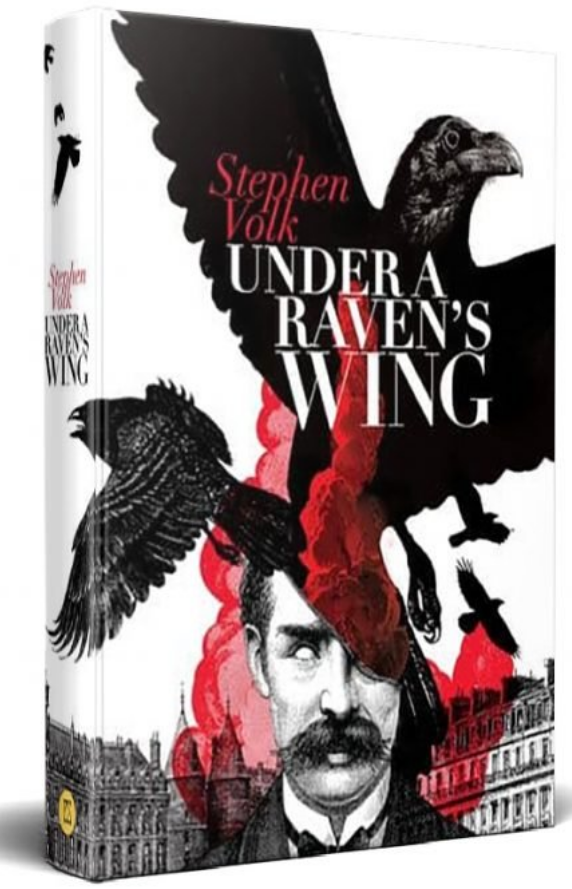
Number 47 - Under A Raven's Wing - Stephen Volk

First thing to do is thank PS Publishing for sending me this as a review copy.  It truly is a thing of beauty. As you'll notice when you scroll I've even included pictures of the artwork on the inside. 

The designer Pedro Marques deserves a special mention for his work here.  It is a fabulous looking book.

 Is the meat of the book worthy of such an amazing looking skin? The answer is "hell yes!"

I'm not a great fan of mash up fiction in general. It normally feels gimmicky and not particularly imaginative. However, this book shows how it should be done.

It's a collection of seven novellas (two previously unpublished) featuring Sherlock Holmes as a young man, training with his mentor in Paris.  His mentor is none other than C Auguste Dupin, the original master detective created by Edgar Allan Poe.  

Of course, even in the Sherlock Holmes reality, Dupin was a fictional character and is referenced in at least one of Doyle's original stories is handled in a brilliant and unexpected way.
These are told from Holmes' point of view in a series of manuscripts sent to Lestrade. With  Holmes as the apprentice to Dupin, this puts him firmly in the Watson role in these stories. 

With the very strong Poe influence, these stories are very much horror stories as much as they are detective stories. Other influences that appear are Jules Verne, Victor Hugo, Gaston Laroux  and others. 

The research that's gone into these stories is obvious.  There are many Easter eggs for fans of the original Poe and Doyle stories. Origins are given for some of the more famous attributes of the older Holmes. Not having read widely in the original Conan Doyle stories I feel like I've missed out on several in jokes, but I picked up on enough to appreciate the love for the source material.

There are scenes in this book that I found frankly terrifying - particularly in the Three Hunchbacks story. Those who've read it will know the scene I'm talking about.

Volk's prose suits the voice you'd imagine Holmes to write in. There's a humanising element of self doubt and fallibility, as you'd expect since he's the apprentice this time around and learning his craft from the master. 

If I was to make any criticism of the book, I would just say that the Celestine Blot story should maybe have been the fourth or fifth story because something that happens in it seems to place it later in the timespan. But that's a very minor matter and the stories are in the order they're in because that's the order they were first published. 

To conclude, this is a great collection from a great writer.  This is how mash-up fiction should be written, intelligent, witty, intriguing and well thought out and researched. 

Avaialble through PS Publishing 


Tuesday, 25 May 2021

Number 46 - Outcast Volume 2 A Vast and Unending Ruin


Doncha just love a cheerful title like that?

Volume 2 of this Kirkman scribed series continues in much the same vein as volume 1.

The demonic forces surrounding Kyle are closing in, attacking more of his loved ones. His quest to discover what his abilities actually are takes a turn for the worse.  Is he actually helping some of the people he casts the demons from, or is his cure worse than the illness?

This series is much more dialogue driven than TWD ever was.  It needs to be though.  The action would be pretty confusing otherwise.

The artwork is mostly excellent and the stroyline continues to intrigue.

It's a very quick read with no real hidden depths, so this is a similarly short write up.  I should have done it yesterday, but I got sidetracked trying to update the music on my iphone after it randomly decided to grey out half the songs so they couldn't be played.

Dealing with iTunes really is a nightmare scenario. It's the most bug-ridden piece of shit software ever written.

Sunday, 23 May 2021

Number 45 - Lean, Fall, Stand - Jon McGregor


The award for worst book cover of the year so far goes to this book.  If I hadn't been following Jon McGregor's career since we read his debut novel If No One Speaks of Remarkable Things at my book group several years ago, I would never have given this a second glance. It doesn't stand out on the shelves and from a distance the title is remarkably difficult to spot. 

That's the negative over with.

As mentioned, McGregor is one of those writers I've been following since his debut over a decade ago.  I own all his books and there isn't a bad one in there.

This one is no exception. 

It opens in Antarctica where, on a quick trip out from the research base to get some photographs, things start to go horribly wrong.  A storm descends quickly and the three members of the party are separated. to compound the problem, the most experienced member of the team (Doc) falls very ill.

The story shifts from there to follow Doc's recovery.  This is told from the point of view of his wife initially before expanding in the final section.

As usual McGregor's prose sings from the page. His writing truly is a thing of beauty. When I say it sings from the page, think ethereal heavenly chorus rather than dodgy karaoke bloke down the pub after seventeen pints. 

In this book, in addition to the beauty of the writing, we have his strongest narrative to date. in most of his other books, he tells big picture stories. In his debut, he painted the picture of a very normal street and made the mundane seem magical. In Reservoir 13, he followed the lives of an entire village in the wake of a tragic disappearance, but crucially, never definitively tried to solve it, just showed us the impact on the people affected.

Here, he manages to follow the ripples of the events in in the first chapters but keeps it personal, and aims for closure at the end of the story. It's the closest to traditional beginning, middle, end that he's written.

He manages to keep up with his usual playfulness with structure and form and word choice. 

The book is split into three parts, called Lean, Fall, and Stand. The separators used to denote time shifts between paragraphs in each of the three segments of the book are \, _, and | in that order. it took me far longer than it should have done to make the connection.

The depiction of the onset of Doc's illness is shocking and brilliant in the way his language becomes more and more confused.  

When he finally returns home we truly feel the exhaustion of his wife. She's a career woman who's used to spending anywhere from 4 to 12 months of the year with her husband pretty much as far as he could possibly be away from her.  Now she's his full time carer. 

For several chapters nearly every line begins with the same phrase, "She had to", hammering home the impact this is having on her. This lessens off as he gains his independence again.   

This is a real contender for best book of the year. A beautifully told told story of disaster and recovery. He manages to be moving and funny and sad all at the same time, frequently in the same sentence.  That's how good McGregor's writing is.

Buy. 

Read. 

Enjoy.


Sunday, 16 May 2021

Number 44 - Outcast - Kirkman and Azaceta


 I'm allowed to post this review straight off. 

This is the first volume in a series by the writer of the Walking Dead comics.  Issue 1 was included as an extra at the back of one volume of TWD so I knew that this was a newish take on the old demonic possession trope.

The lead character appears to have the ability to cast demons out of people but it ain't pretty so he isn't well liked and tends to keep to himself as a result. He's an outcast in two senses.

I do like a good play on words so that's always a good sign.

There's probably more dialogue in this one volume that there was in the last dozen TWD volumes.

There's a conspiracy building around poor Kyle, our Outcast. the demons have been following him since childhood, possessing his nearest and dearest, leading to his self imposed exile. He's returned to his home town at the same time as the demons seem to be widening their reach.

The artwork is top notch. The story is suitably gruesome  and violent. It's a good deal more intelligently written than TWD. The storyline looks like it could be much stronger than the standard post apocalypse fun that made up that series.

The cast is much smaller at the moment, so there isn't as much scope for killing off lead characters. This could lead to tighter plotting, or an extended cast. We'll see what happens.

Overall, a cracking start to the series. I will be picking up vol 2 ASAP.


Saturday, 15 May 2021

Number 43 - insignificance - James Clammer


This is the latest book from one of the best small presses in the UK. From the books I've read so far from this publishing house, their roster is made up of some of the most talented writers at work in the UK today.

James Clammer is another completely new name to me.  This edition comes with no cover blurb so I basically went in completely blind and not knowing what to expect.

Insignificance is the story of one hellish day in the life of a down on his luck plumber in an unnamed town in middle England. He's recovering from a nervous breakdown, the reasons for which become abundantly clear as the narrative continues, and he's out on his first job since his recovery. We also meet his born again Christian wife and their estranged son. To say much more about the story would be a spoiler.

Clammer writes in an unusual and almost poetic style, and it's that that makes this book so compulsively readable. If you'd told me that a man trying to drain a boiler could be as immersive a reading experience as this, I would have laughed in your face.  But the power of Clammer's prose makes the mundane seem strangely significant and meaningful. The sentence structure is deeply unusual and wrongfoots the reader (in a good way) on a regular basis.

The early part of the novel puts us firmly in the man Joseph's head. It's not the happiest place in the universe to be. this is an unimportant man who things just happen to and he knows it. his recovery is not yet complete. The writing is so good we feel his physical and mental wounds equally.
 
For a book with a distinct lack of real action, this really put me through the emotional wringer - especially in the latter half of the book. The man Joseph is an everyman and totally relatable. His relationship with his wife and son are heartbreakingly rendered.

Being just a snapshot of one day in his life, this book does leave many threads hanging in the air.  Fans of a closed narrative with a clearly defined resolution to any drama will probably find this frustrating. Fans of good, intelligent writing about people who feel real will love it.

Tuesday, 11 May 2021

Number 42 - The Restaurant at the end of The Universe - Douglas Adams


 “The story so far: In the beginning the Universe was created. This has made a lot of people very angry and been widely regarded as a bad move.”

 With an opening line like that, how can a book go wrong?  In this case it certainly can’t.

The Hitchhikers trilogy (all 5 books) have been a staple part of my existence since I was about 12.  Whenever I hit book 42 in a year, it has to be a HHGTTG related tome – if that isn’t the law it should be, and this year I decided on a long delayed reread of book 2.

Accidentally, I’ve chosen a very appropriate time to post this review as it’s the 20th anniversary of Adams’ sad death.

This second part of the 5 part trilogy is a very loose adaptation of the last two episodes of the first radio series, and the first 3 episodes of the second. The first book finished with our favourite space travellers boarding the Heart of Gold on the planet Magrathea.

The second starts straight after the events of HHGTTG when Eddie the onboard computer on the Heart of Gold spaceship shutting down to help the drinks machine work out how to make a good cup of tea, just at the moment that a Vogon ship is about to launch an attack.

We're then launched into the events from the first couple of episodes of the second series, where Zaphod finds he's set himself a mission and wiped his memory of it. He soon finds himself at the headquarters of the Guide's publishers where the psychic lifts don't want to take him to the 15th floor.  They know what's about to happen.

After various misadventures involving a sense of perspective, fairy cake, and missing lemon scented napkins, he is reunited with the rest of the cast and they make their way to Milliways.  From then on the book pretty much follows the end of series 1 of the radio show, with a brief diversion to episode 3 of series 2. 

There's not a single page of this book that doesn't contain laugh out loud funny jokes, and/or seriously groan inducing puns.  The wordplay is genius throughout and Adams' natural cynicism shines through all of it.  I always wondered who was to blame for my sarcastic sense of humour.  rereading these points to a very likely suspect.

All 5 books in the trilogy are comic masterpieces.  Please note I don't count book 6 as part of the trilogy.  The end of Mostly Harmless makes it clear that Adams wanted it all to stop so he could write something else for a change. So book 6 was a cash cow and nothing else. 

Not much else to say.  Adams was a comedy god and is sadly missed. 

If you've not read the books, read them now and that's an order.

Friday, 7 May 2021

Number 41 - the Guest Cat - Takashi Hiraide


I chose this randomly as a cheat read since it's only 140 pages. It also has a cat on the cover.  That will make me pick books up randomly/  My standards are not always the highest.

Sadly, despite me being a huge cat lover, this book doesn't quite cut the mustard.

The story is basically two writers semi adopt the neighbour's cat that comes to visit. That's it. No drama, not much of anything at all.  140 pages of a man talking about his life in the year that a cat would pop into their garden and house from next door.

The prose is pretty enough for a translation. But it's all just a little bit dull. I didn't find any real hidden depths in this.  Not many shallows either.  A few semi-connected musings on the nature of art and nature crop in. 

The best thing about this book is the cute cat picture on the cover. 

The reviews on the back talk about how profound and moving it is and how you'll want to read it more than once. I disagree. I hoped to lve this book.  I'm a huge cat lover myself, and this book occasionally gives a vague peak into why we like cats, but mostly it doesn't pull on any of my personal heartstrings.  

Pleasant but dull is the best I can say about this one I'm afraid. 5/10 just for the occasional semi-poetic writing. 

Sunday, 2 May 2021

Number 40 - Where the Crawdads Sing - Delia Owens


This month's book group book. It's obviously a popular choice - 5 million copies sold before this printing alone, and most book groups on Facebook, it seems to crop up in someone's listings at least twice a day.

Does it deserve the attention and the sales?

I think it probably does. But there are some definite flaws to the story. Unfortunately, some slight spoilers will be needed to say what these flaws are. I'll try to be vague as possible but you might want to skip this review if you don't want clues.

Kya is better known to the locals as the Marsh Girl.  She was abandoned by her family one by one until she was left alone living in a run down shack in the marshes aged about 9.  Since then she's fended for herself with only the help of one or two friendly locals - from the black people's side of town.  this story being set between 1953 and 1970, means it's deep in the American racist era.

As she grows up aloe in her run down hut, she catches the attentions of two local boys, one nice, one not.

The book opens with the not nice one found dead in 1969, before flashing back to 1953 when Kya's mother walked out.  the chapters alternate randomly between the sheriff's investigating the death, and Kya's growth from child to young adulthood. 

It's all very nicely written. the characters are drawn so well you can almost see them, We have full sympathy for Kya. We understand fully her first encounters with love from her two suitors. there's real tension in the scenes set in 1970. we don't want to see an innocent person suffer.

I really enjoyed this book and was ready to class it as one of the best I've read this year until the revelations in the final three pages which undermine all the messaging in the rest of the book. All the good work up until that point is spoiled.  And the worst thing is, it wasn't necessary.  They could have picked a number of other people, or just left it as a tragic accident and the ending would have been so much better.

It's Owens's first novel, so I will let her off on this occasion. It's a fascinating and moving read with a genuinely sympathetic protagonist. But she fluffs the ending so badly... it's worse the more I think about it. It doesn't actually make much sense as a solution to the events for several reasons.

a generous 7.5/10.  If I think about this much longer, that may slip